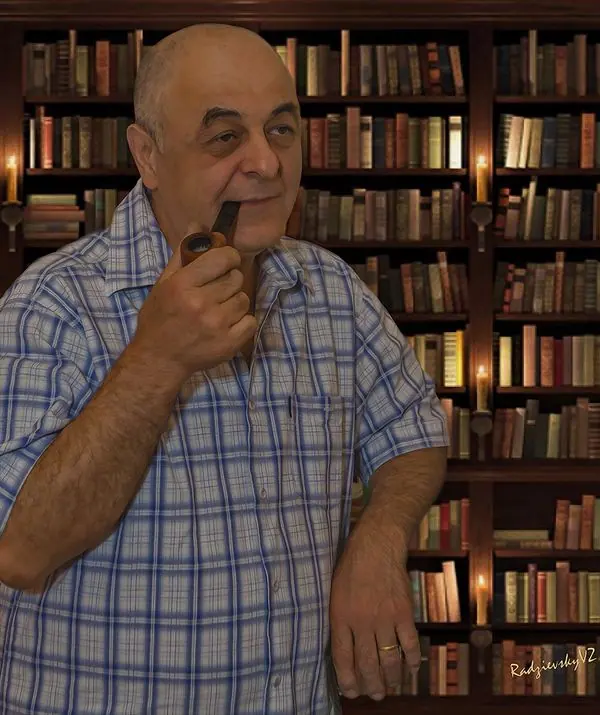
The maker
An engineer’s pipe,
a jeweler’s hand.
Design engineer and jeweler by training, pipe maker by a question that would not leave him. He still lives in Yerevan. The pipes still leave one at a time.
Levon Asikyan was born and raised in the Republic of Armenia. For a long while he worked as a professional design engineer. In the years that followed he became a jeweler — setting stones, cutting metal, learning how a small object can be both precise and personal.
He already smoked. Virginia flakes, sometimes a light aromatic; a rack of about a hundred pipes. In 2015 he began to ask why some of them smoked better than others. The answers, he decided, were in the making.
He started at the bench in 2016, reading the Danish makers first — their slim shapes, their tight lines, their refusal to decorate what the wood had already said. The hobby hardened into a workshop. In 2019 it took a name: Asikyan’s Pipes.
Jewelry is still the day’s work. It pays for the tools and keeps the atelier open. On a silver or brass band you may find an Armenian petroglyph — a mark from stone, transferred to metal, then to a pipe that will live in a pocket.
Pipedia describes the work plainly: classic factory silhouettes, often rather slender, with lines held taut. The briar is excellent Algerian stock, sometimes Italian, chosen for the shape already waiting inside. Every mouthpiece is cut by hand to the pipe it belongs to.
Engineering keeps the drilling true. Jewelry keeps the silver honest. A pipe that is only beautiful is a sculpture. A pipe that is also correct — draught hole, chamber wall, button, balance — is a companion.


From the bench
Why the pipe smokes.

He wanted to understand why some pipes in his own rack were better than others. Then he built the answer.
The first work was study: articles, remarks from recognized makers, the geometry of a chamber and an airway. Then the lathe, the drill, the file. The block is read before it is cut. The chamber and the airway are drilled next, so the engineering is true before the sculpture begins.
That is the Armenian workshop’s quiet claim: the Danish line, held to an engineer’s tolerance, finished by a jeweler who still likes to smoke.
A smoker’s rack of about a hundred pipes. Why did some of them smoke better than others?
First pipes, cut after the Danish masters — slim shapes, tight lines, engineering before ornament.
The hobby took a workshop’s name: Asikyan’s Pipes. The stamp settled: Armenia · Asikyan · Hand Made.
About a hundred pipes leave Yerevan each year, each numbered, pouched, and boxed with the emblem.
The mark
How to read an Asikyan.
Country, signature, Hand Made, then the serial. The first three digits are the count. The last two are the year. From pipe 116/21 the stem also carries two letters of the Armenian alphabet — AL, for Asikyan Levon.


Shapes
A Danish vocabulary, spoken in Yerevan.
Classic factory silhouettes, often slim, with the occasional freehand, bamboo, or double wall. The list below is from the Pipedia catalogue — the same family you will find in the collection.