Where it comes from
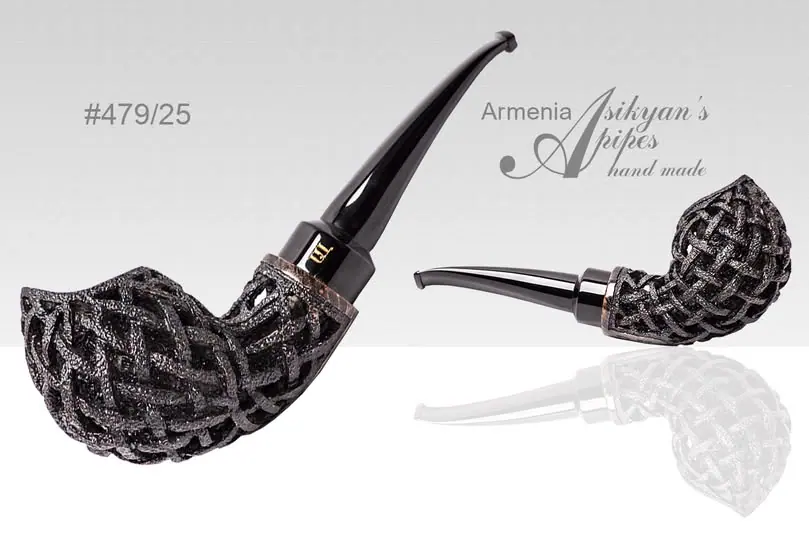
Freehand, as a category, is a Danish idea from the 1950s and 1960s. Sixten Ivarsson taught that the block decides the outline; Preben Holm and others turned “freehand” into a shop word for pipes that refuse a factory stencil. The plateau stays, the heel can flare, the cage can be carved open. It is not an unfinished billiard. It is a decision to follow the wood. Levon’s lattice pieces sit in that line, cut in Yerevan.
The specification
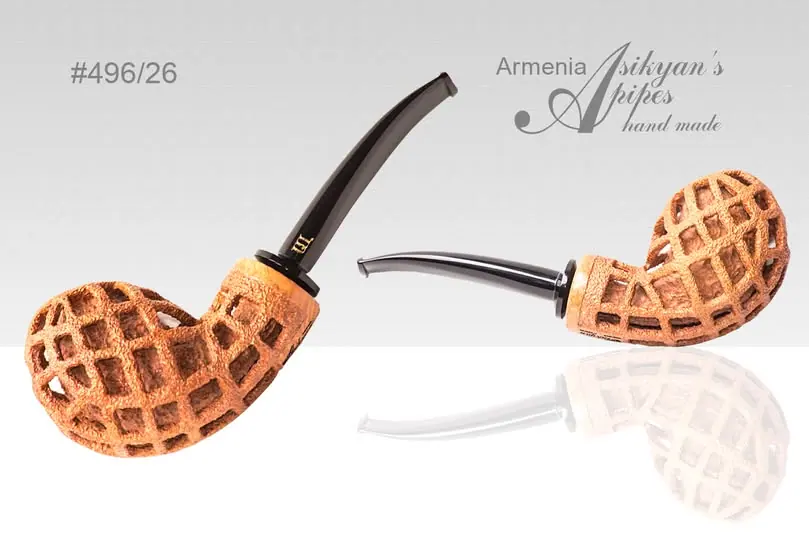
There is no fixed length or chamber chart — that would be a factory list. What is specified is the engineering: a drilled airway, even chamber walls, a stem cut to the pipe. On the double-wall freehands the outer cage is carved open and the inner bowl is held apart. Smoke does not travel through the ornament. The ornament is the wall you can see. 496/26, 481/25, 479/25, 359/23 and 357/23 are that construction. No millimetre cards on those plates.
Plates in the cabinet
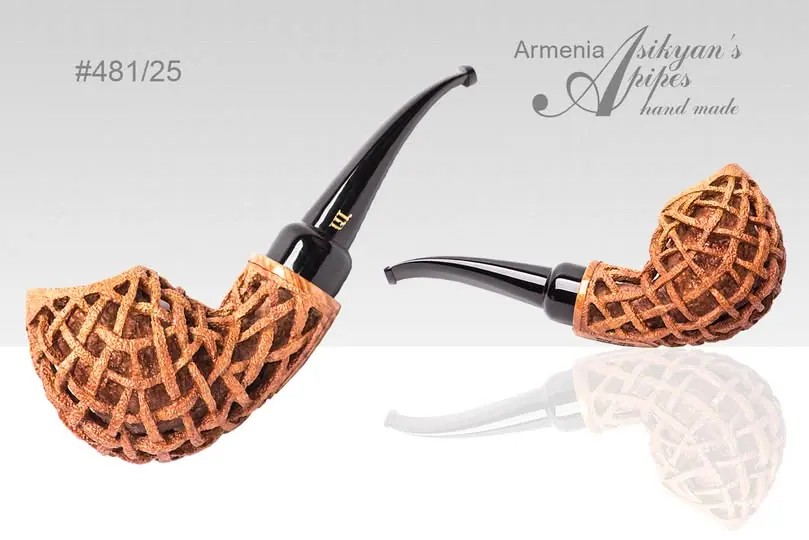
496/26 is a lattice freehand from the current stock album. 481/25 is a basket-weave double wall from 2025. 479/25 is darker, with a bronze ferrule. Each serial is one pipe. There is no “model 496” next year. The flower 360/23 is a freehand of another outline — flared heel, no lattice.