Where it comes from
A classical calabash is an African gourd fitted with a meerschaum cup — a late-nineteenth-century fashionable pipe, the silhouette later tied to Sherlock Holmes. Smoke expands in the gourd and cools before the bit. A reverse calabash keeps that idea and moves the expansion chamber into the briar itself, usually a swollen shank or a cavity behind the bowl. That briar version is a twentieth- and twenty-first-century artisan technique, not a Saint-Claude stencil and not a gourd. German and Danish makers used it; Levon drills it on a Danish line in Yerevan.
The specification
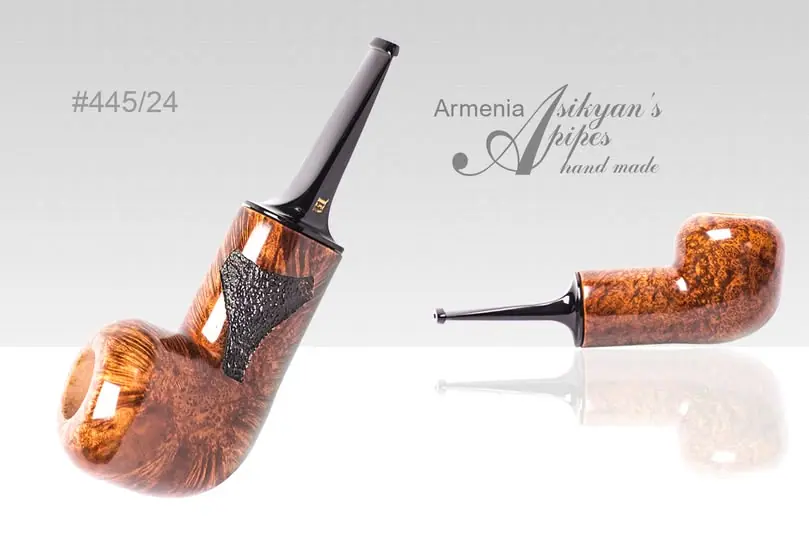
The specification is the second chamber: it must be drilled true, or it is only a hole. The outline can be almost any bowl — 445/24 reads as a smooth, partly rusticated pipe; 462/25 is a ukulele that is also reverse-calabash. We do not invent millimetres for 445/24. The extra wood usually makes the shank heavier than a billiard of the same bowl.
The plate in the cabinet
445/24 is the reverse calabash photographed here: a rusticated panel cut into an otherwise smooth, flamed bowl, 2024 archive. eBay titles sometimes list other reverse-calabash serials we have not plated. Those pages wait for a real photograph. The stamp is the same as every other Asikyan pipe.
When to choose it
If you want a cooler, drier smoke and you accept a little more shank, this is the construction to ask about. It is not a billiard with a gimmick. That is why it sits with the engineer’s work.