Where it comes from
The billiard is the default briar pipe of the late nineteenth century. French and English factories — Saint-Claude first, then London — needed a bowl that drilled evenly, sat in a case, and looked like the older clay “cutty” without the long churchwarden stem. The name is usually taken from the cylindrical bowl, compared at the time to a billiard ball stood on a shank. Dunhill, Charatan, GBD and a dozen Saint-Claude houses made it the first shape in every catalogue. It is not an Armenian invention and not a Danish one. It is the industrial classic Levon still starts from.

The specification
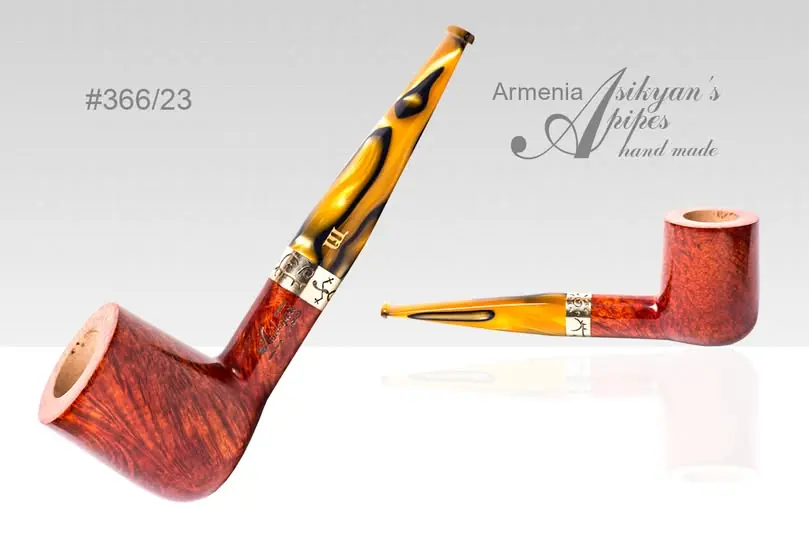
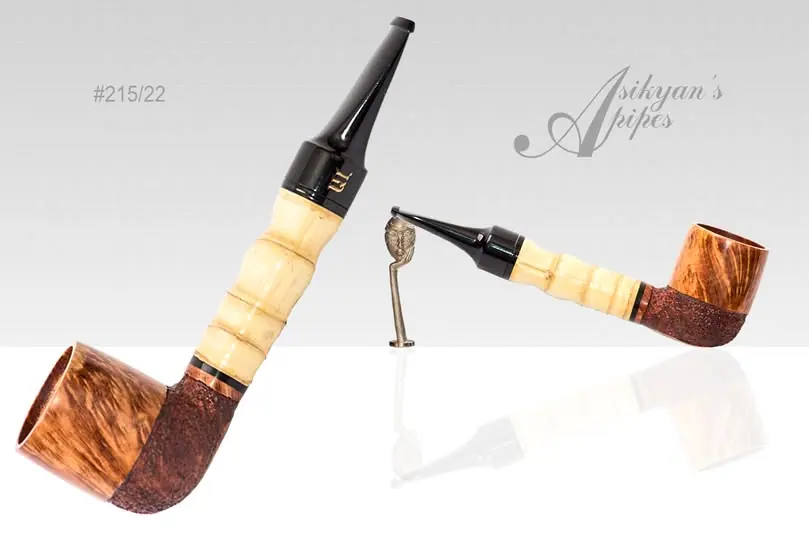
A billiard has an upright, roughly cylindrical bowl, a straight round shank, and either a tapered or a saddle stem. The chamber is a true cylinder, not a cone. Walls should be even. There is no bead line and no diamond shank — those belong to the bulldog. Billiard 370/23 in the cabinet is a measured example: 154 mm long, 67 g, chamber 20 × 46 mm, bowl 55 mm high, 41 mm outside. That is a tall, classical English proportion, kept slim at the waist. Other Asikyan billiards (366/23, 355/23, 391/24, 215/22) follow the same upright geometry; we only print millimetres when the plate has them.
How Levon cuts it
His billiards stay Danish-tight: no factory bulk at the transition, rustication cut by hand when the grain will not carry a polish. 370/23 is rusticated, with a colored ebonite stem and a brass band carrying an Armenian petroglyph. 366/23 is a tall smooth sister with a yellow-black acrylic stem and a silver petroglyph band. 215/22 splits the bowl half-and-half — smooth grain above, rustication below — on a three-knuckle bamboo shank. Same silhouette, three surfaces. The stamp is always Armenia · Asikyan · Hand Made, then the serial.
Next to a Lovat or a Liverpool
If the bowl is the same but the shank is longer and the bit is a saddle, you are looking at a Lovat. If the shank is longer and the stem tapers, it is a Liverpool. The billiard is the short, straight member of that family. Start here if you want the shape most smokers already know, cut one at a time in Yerevan.