Where it comes from
The Dublin is older than most of the English fancy names. A conical bowl that opens toward the rim was already how many clays and early briars were drilled: the knife followed a flare. Irish and English factories kept the name “Dublin” on that cone. Saint-Claude exported it by the thousand. It is not a billiard (the walls are not parallel) and not an acorn (the rim is the wide end, not the pinched one).
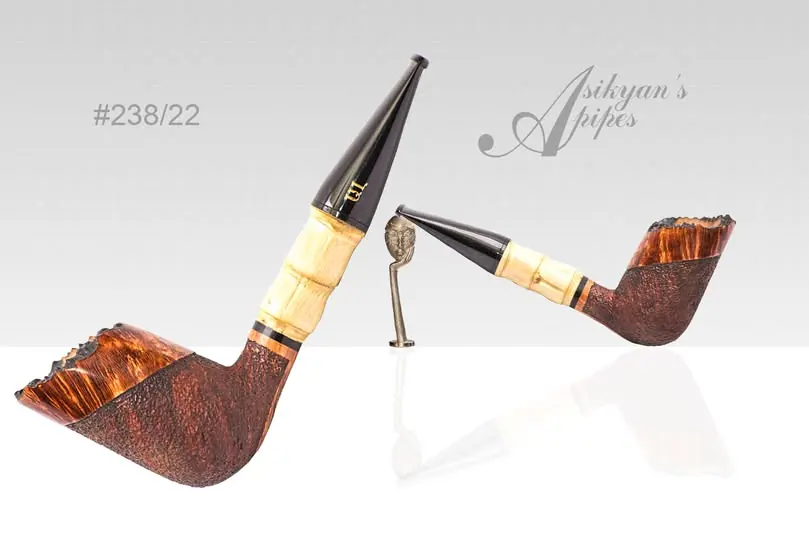
The specification
Bowl: truncated cone, wider at the rim than at the heel. Chamber: often follows that cone. Shank: straight or lightly bent; 238/22 uses two knuckles of bamboo. Stem: cut to the shank. Neither Dublin in the cabinet has a millimetre card. What the plates show is the flare and the plateau or stacked rim.

Two from 2022
238/22 is a plateau Dublin: rusticated heel, flame grain above, bamboo shank. 232/22 is smooth straight grain with a stacked rim — black, cream, and rusticated layers. Same year, same silhouette, two different rims. That is how Levon uses a classical name without repeating a pipe.